


Vacuum Forming vs Pressure Forming: Choosing the Right Machine for Your Dental Lab

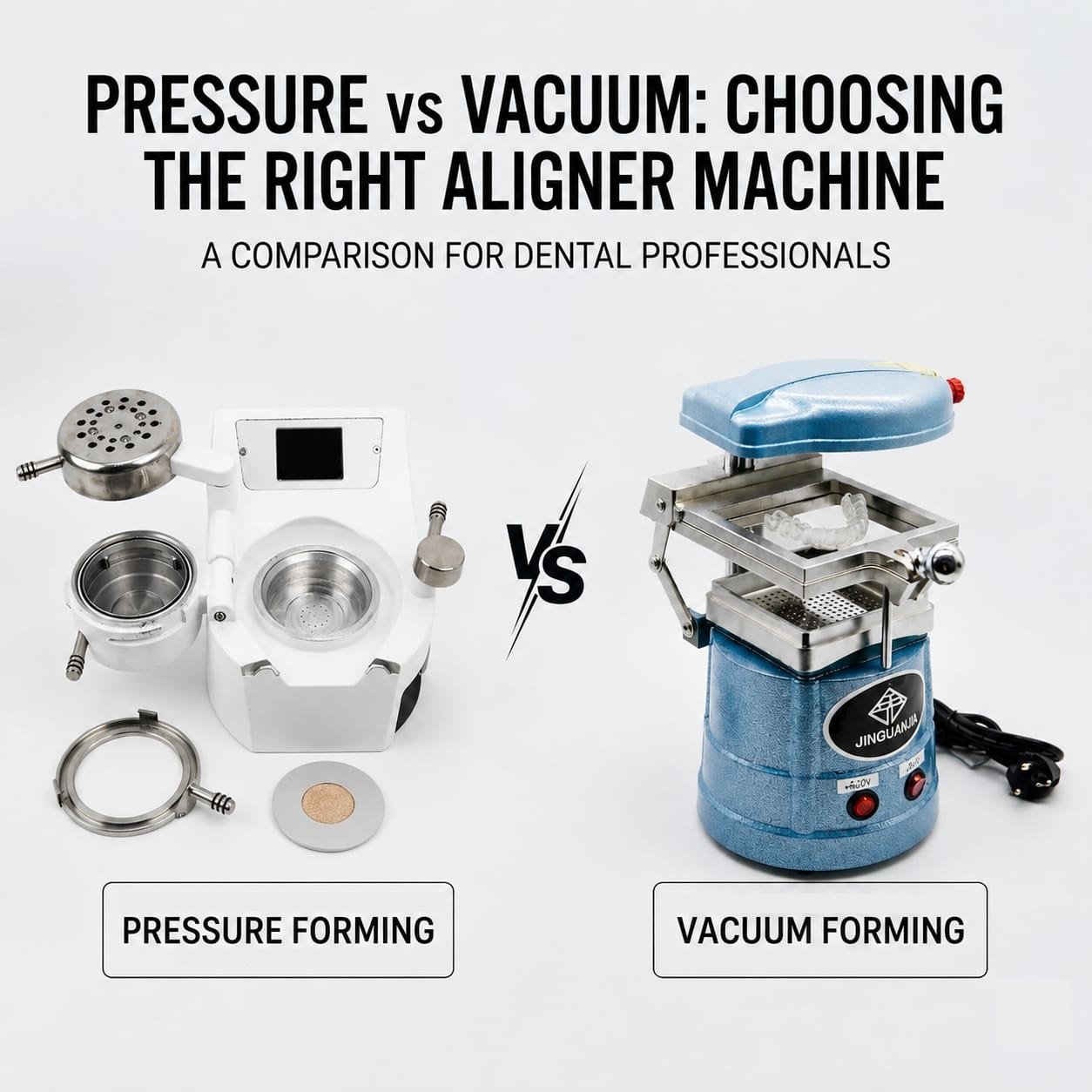
# Vacuum Forming vs Pressure Forming: Choosing the Right Machine for Your Dental Lab
For labs producing aligners, retainers, and splints in-house, the choice between a vacuum forming machine and a pressure forming machine can significantly affect the quality and consistency of your final product. Here’s what to know before you invest.
# How Vacuum Forming Works
Vacuum forming machines heat a plastic sheet until pliable, then use suction to pull the softened material tightly over the dental model. It’s a well-established, cost-effective method widely used for basic retainers, mouthguards, and simpler appliances.
Pros:
– Lower equipment cost
– Simpler operation, faster learning curve
– Well-suited for single-layer materials and less complex cases
Limitations:
– Can struggle to capture fine detail in undercuts and complex anatomy
– Less consistent thickness distribution across the appliance
# How Pressure Forming Works
Pressure forming machines apply positive air pressure (rather than suction) to push the heated sheet onto the model — often at pressures up to several bar. This creates significantly more force than vacuum alone, allowing the material to capture finer detail.
Pros:
– Superior detail capture, especially around undercuts and interproximal areas
– Better suited for multi-layer materials like hard-soft-hard aligner sheets
– More consistent, tighter fit — important for clear aligner accuracy
Limitations:
– Higher upfront equipment cost
– Slightly more involved setup and pressure calibration
# Which One Should Your Lab Use?
If your lab primarily produces basic retainers or mouthguards , a vacuum forming machine may be sufficient and cost-effective.
If you’re producing clear aligners , especially with multi-layer hard-soft-hard sheets, a pressure forming machine is generally the better investment. The added pressure ensures the layers form accurately around the model without losing detail — which directly affects how well the finished aligner fits and performs.
# Compatibility with Sheet Formats
Many modern pressure forming machines — including the models we supply — are compatible with **both round and square sheets**, giving your lab flexibility without needing to standardize on one material shape.
# Final Thoughts
Your equipment choice should match the complexity of the cases you handle. For labs scaling up aligner production or working with multi-layer materials, upgrading to pressure forming is often a worthwhile step toward better consistency and case quality.
DentSupply supplies both vacuum and pressure forming machines suited for dental labs across Pakistan. Get in touch at info@dentsupply.pk or 0321 5622110 for guidance on the right setup for your lab.