


Understanding 3-Layer (Hard-Soft-Hard) Aligner Sheets: Why They Matter for Patient Comfort

# Understanding 3-Layer (Hard-Soft-Hard) Aligner Sheets: Why They Matter for Patient Comfort
Not all aligner material is built the same. If you’ve been using single-layer sheets and are considering an upgrade, understanding how 3-layer hard-soft-hard sheets work can help you decide whether they’re right for your lab.
# What Is a 3-Layer Hard-Soft-Hard Sheet?
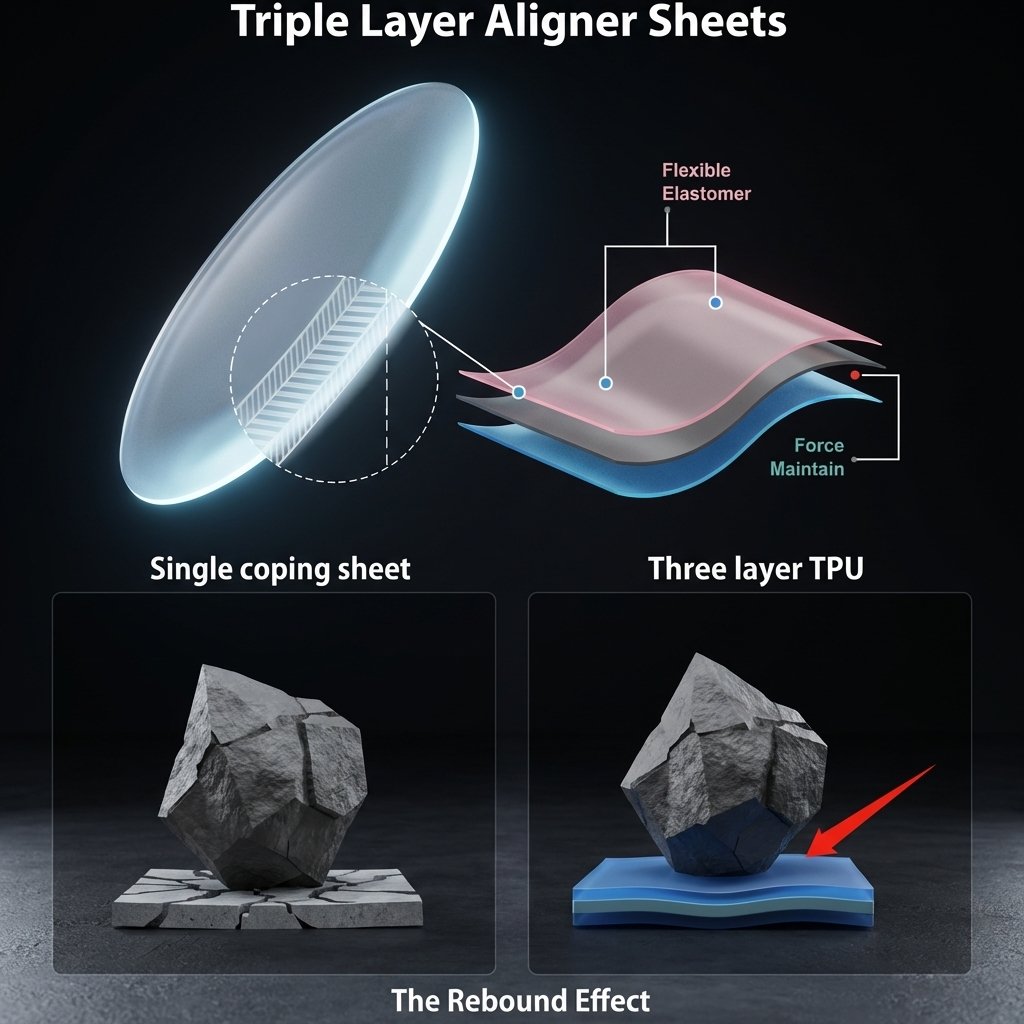
As the name suggests, this type of sheet is made of three bonded layers:
1. Outer hard layer — provides structural rigidity and shape retention
2. Inner soft layer — cushions against the teeth and gums
3. Outer hard layer — mirrors the first layer for balanced strength on both sides
This sandwich construction is different from single-layer PETG or TPU sheets, which are either fully rigid or fully flexible throughout.
# Why the Combination Works
Retention and Force Control
The hard outer layers give the aligner enough rigidity to apply consistent, controlled force to the teeth — which is essential for effective tooth movement over the course of treatment.
Patient Comfort
The soft middle layer sits directly against the tissue, reducing irritation, pressure points, and the “sharp edge” feeling patients sometimes report with fully rigid aligners.
Durability
Multi-layer construction tends to hold its shape better over the wear cycle compared to single-layer soft materials, which can lose rigidity and tracking accuracy over time.
# Choosing the Right Thickness
Hard-soft-hard sheets are typically available in a few standard thicknesses, most commonly 0.76mm and 0.89mm:
– 0.76mm is a popular choice for standard clear aligners, offering a good balance of comfort and force delivery for routine cases.
– 0.89mm provides slightly more rigidity, often preferred for cases needing stronger retention or for patients with more demanding wear patterns.
Your choice should be guided by the specific case, the patient’s treatment plan, and your clinician’s preference.
# A Note on Handling
Multi-layer sheets generally form well on standard vacuum and pressure forming machines, but heating time and pressure settings should follow the manufacturer’s guidelines to avoid layer separation or uneven forming.
# Final Thoughts
For labs and clinics looking to improve patient comfort without compromising on treatment effectiveness, 3-layer hard-soft-hard sheets are worth considering as a step up from single-layer materials.
DentSupply stocks multi-layer aligner sheets in both 0.76mm and 0.89mm thicknesses. Contact us at info@dentsupply.pk or 0321 5622110 to discuss what fits your lab’s workflow.