

Desktop 3D Scanner vs Intraoral 3D Scanner: Understanding the Key Differences in Digital Dentistry

Digital dentistry has transformed the way dental professionals diagnose, plan treatments, and manufacture restorations. Traditional impression techniques are rapidly being replaced by advanced 3D scanning technologies that improve accuracy, efficiency, and patient comfort.
Among the most important innovations in modern dentistry are Intraoral 3D Scanners and Desktop 3D Scanners. While both devices create highly accurate digital 3D models, they serve different purposes within the digital workflow. Understanding their differences can help dentists, dental laboratories, and clinic owners choose the right technology for their practice.
What is an Intraoral 3D Scanner?
An intraoral 3D scanner is a handheld digital device used by dentists to capture precise three-dimensional images of a patient’s teeth, gums, and oral structures directly inside the mouth. Instead of using conventional impression materials such as alginate or silicone, the scanner captures thousands of images every second and converts them into a detailed digital model in real time.
The digital impression can be immediately viewed on a computer, allowing the dentist to evaluate the scan, make corrections if necessary, and send the file electronically to a dental laboratory or CAD/CAM system.
How Does an Intraoral Scanner Work?
The dentist moves the scanner smoothly across the patient’s teeth while integrated cameras and structured light technology capture multiple images from different angles. Specialized software stitches these images together into a highly accurate 3D model of the patient’s mouth.
Within minutes, the digital impression is ready for restorative design, implant planning, orthodontic treatment, or smile design.
Advantages of Intraoral 3D Scanners
One of the biggest advantages of intraoral scanning is improved patient comfort. Many patients dislike traditional impression trays because they can trigger gag reflexes and cause discomfort. Digital scanning eliminates this experience entirely.
Other major benefits include:
-
Faster clinical workflow
-
Immediate digital impressions
-
Excellent accuracy
-
Reduced need for impression remakes
-
Better communication with dental laboratories
-
Easy integration with CAD/CAM systems
-
Improved patient education through real-time 3D visualization
-
Digital record storage without physical models
Common Applications of Intraoral Scanners
Modern intraoral scanners are widely used for:
-
Crown and bridge restorations
-
Dental implants
-
Veneers
-
Orthodontics
-
Clear aligner treatment
-
Full-mouth rehabilitation
-
Smile design
-
Digital treatment planning
-
Patient consultation
Because of their speed and convenience, intraoral scanners have become an essential investment for clinics transitioning toward a fully digital workflow.
What is a Desktop 3D Scanner?
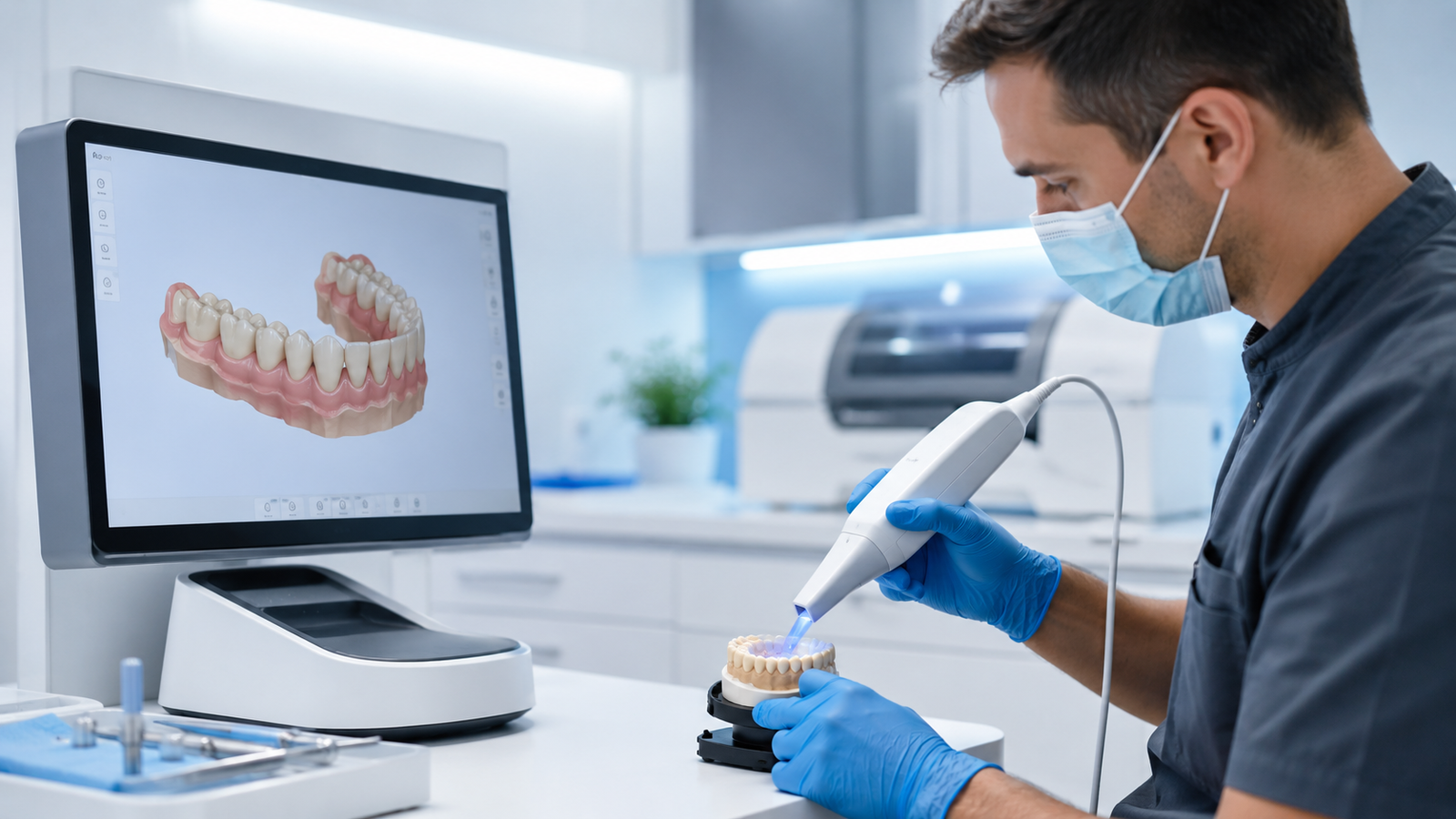
A desktop 3D scanner is designed primarily for dental laboratories and CAD/CAM production centers. Unlike an intraoral scanner, it does not scan patients directly. Instead, technicians place physical objects such as stone casts, dental impressions, removable dies, implant models, or wax-ups inside the scanner.
Using multiple high-resolution cameras and structured light technology, the scanner captures every surface of the model with exceptional precision and converts it into a digital file suitable for CAD software.
Desktop scanners play a vital role in modern dental laboratories by converting traditional physical models into digital restorations.
How Does a Desktop Scanner Work?
The technician places the dental model inside the scanning chamber. During scanning, automated rotating platforms and multiple cameras capture the object from various angles.
The software combines these images into an extremely accurate digital 3D model that can be used for designing crowns, bridges, dentures, implant restorations, and orthodontic appliances.
Most professional desktop scanners support automatic multi-axis scanning, making the process highly efficient and consistent.
Advantages of Desktop 3D Scanners
Desktop scanners are known for delivering laboratory-grade precision.
Their benefits include:
-
Extremely high scanning accuracy
-
Automatic scanning process
-
Ability to scan multiple dies simultaneously
-
Compatible with articulators and implant models
-
Excellent for CAD/CAM manufacturing
-
High productivity for laboratories
-
Digital archiving of physical models
-
Consistent quality across multiple cases
Dental laboratories that process dozens of restorations every day rely on desktop scanners to maintain speed, precision, and repeatability.
Desktop 3D Scanner vs Intraoral 3D Scanner
Although both scanners generate digital 3D models, their workflows are entirely different.
An intraoral scanner is designed for chairside use by dentists. It captures digital impressions directly from the patient’s mouth, eliminating the need for traditional impression materials.
A desktop scanner, on the other hand, is used after impressions or stone models have already been created. Instead of scanning patients, it digitizes physical dental models inside a laboratory.
Another significant difference is the user. Dentists primarily operate intraoral scanners during patient appointments, while dental technicians use desktop scanners during restoration design and manufacturing.
When it comes to speed, intraoral scanners reduce chair time and allow digital impressions to be sent instantly to the laboratory. Desktop scanners focus on laboratory productivity by automating model scanning and producing highly accurate digital files for CAD software.
Which Scanner Offers Better Accuracy?
Both scanners provide outstanding accuracy, but they are optimized for different purposes.
Intraoral scanners are engineered to achieve high clinical accuracy for capturing oral anatomy during patient treatment. Modern systems are more than capable of handling crowns, bridges, implants, veneers, and orthodontic procedures.
Desktop scanners generally achieve even higher levels of precision because they scan stationary physical models under controlled laboratory conditions. This makes them ideal for designing highly detailed prosthetic restorations and implant frameworks.
Rather than competing technologies, they complement each other within the digital dentistry workflow.
Which Scanner Should You Choose?
The right choice depends on your professional needs.
If you operate a dental clinic and want to eliminate conventional impressions, improve patient comfort, and accelerate restorative workflows, an intraoral scanner is the ideal investment.
If you manage a dental laboratory and routinely receive stone models or physical impressions, a desktop scanner is the better option because it delivers exceptional precision for CAD/CAM production.
Many modern dental practices and laboratories use both technologies together. Dentists capture digital impressions chairside and send them directly to laboratories, while labs use desktop scanners whenever physical models need to be digitized. This combination creates a seamless, efficient, and fully digital workflow.
Final Thoughts
Digital dentistry is no longer the future—it is the present. Both intraoral and desktop 3D scanners play essential roles in delivering faster workflows, greater precision, and better patient outcomes.
Choosing the right scanner depends on whether your primary focus is patient care or laboratory production. Clinics benefit most from intraoral scanners, while laboratories achieve maximum efficiency with desktop scanners. Together, these technologies create a complete digital ecosystem that improves communication, shortens turnaround times, and enhances the quality of dental restorations.
At DentSupply.pk, we are committed to providing advanced digital dentistry solutions for dental clinics, hospitals, and laboratories across Pakistan. Whether you are starting your digital journey or upgrading your existing workflow, selecting the right 3D scanning technology can significantly improve efficiency, accuracy, and patient satisfaction.